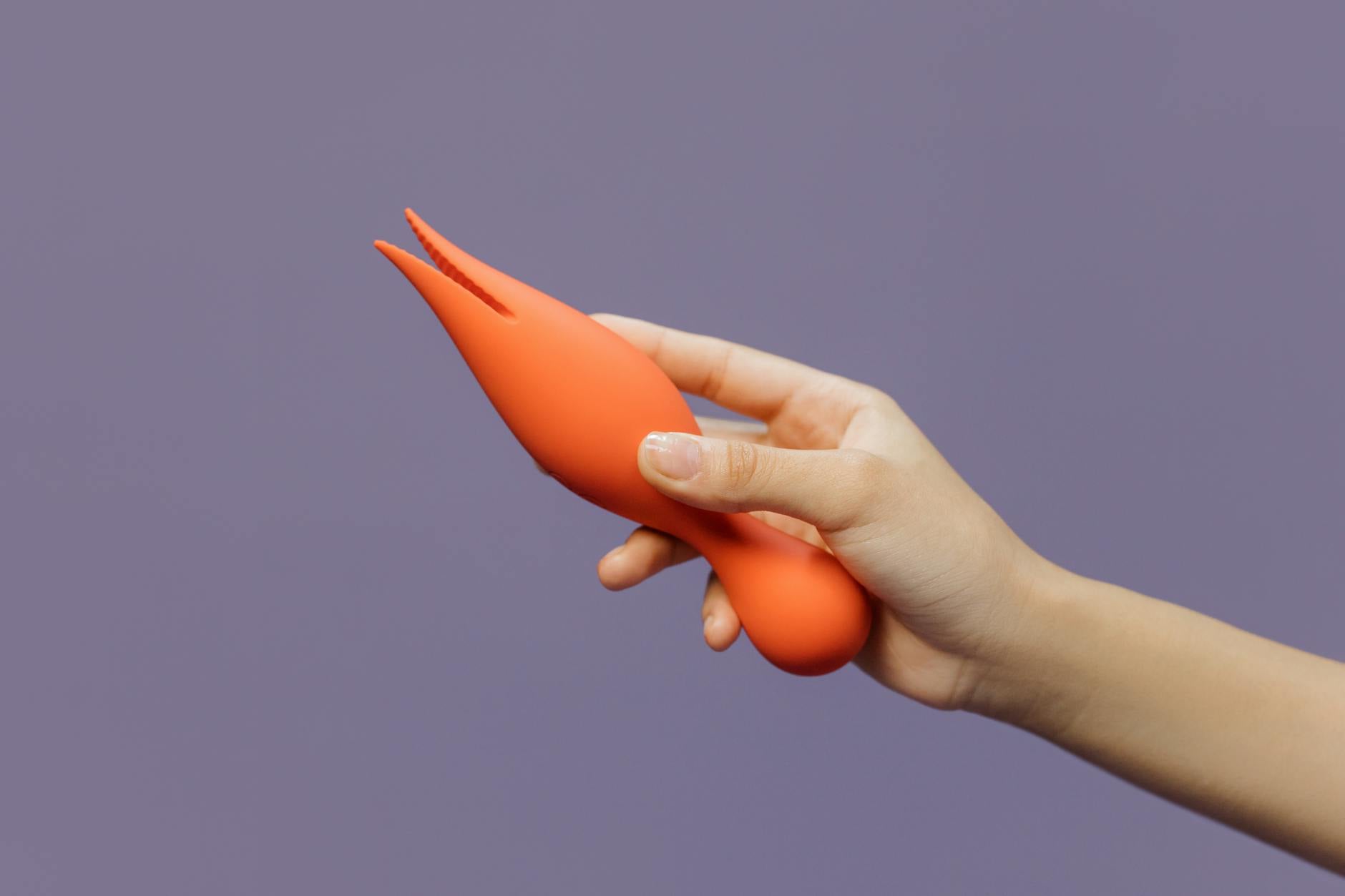
Your cycle isn't just about fertility. It's about sensation.
Let's be real. Your pleasure doesn't stay the same all month. That's not broken. That's biology, and it's actually useful information if you know how to read it. Your lemon vibrator will feel wildly different depending on where you are in your cycle, and understanding why means you can actually work with your body instead of fighting it.
Hormones don't just control ovulation. They reshape how your nervous system responds to touch, how quickly your body builds arousal, and what kind of stimulation feels best. A lemon clitoral vibrator that felt perfect during your follicular phase might feel too intense during your luteal phase. Or the opposite. Knowing this means you're not chasing a fantasy version of pleasure that's somehow "consistent." You're honoring what's actually there.
The follicular phase: sensitivity goes up
The follicular phase runs from the first day of bleeding through ovulation, roughly 14 days (though it varies). Estrogen is rising. Your clitoral tissue is getting thicker, blood flow to your genitals increases, and your nervous system is primed for sensation. This is when lemon vibrators often feel most responsive, most direct.
Your clitoris is more engorged during this phase. The tissue is plumper. This means a lemon sucker or any clitoral vibrator makes contact more easily, and the stimulation often builds faster. You might find yourself reaching orgasm more quickly. You might also find that intensity that felt great on day 5 now feels too sharp on day 10.
What helps: Start at pattern 2 instead of pattern 1. Your body is ready for it. You might also notice that the warm-up time is shorter, so don't force yourself to slow down if your arousal is building on its own schedule. Let it.
Photo by Ihsan Adityawarman on Pexels
You'll also notice your desire is higher. Testosterone peaks just before ovulation, which means your brain is literally more interested in pleasure. This isn't horniness in the frantic sense. It's clarity. You know what you want, and your body is ready to have it. A lemon vibrator works beautifully here because suction creates sustained, focused stimulation that matches the intensity your body is already producing.
Ovulation: the peak window
This is typically 12 to 24 hours, and it's when sensation is probably at its strongest all month. Estrogen peaks. Testosterone peaks. Blood flow to your genitals is at maximum. Your clitoris is fully engorged, and the tissue is at its most responsive.
This is also when many people experience their easiest, most intense orgasms. If you've ever noticed that you came faster and harder on a specific day last month, ovulation is probably why. Your lemon vibrator will likely feel almost effortless to use during this window. You might achieve orgasm in a fraction of the time it takes other days, or experience multiple orgasms back to back.
What helps: Trust your body's speed. You don't need to build slower. You don't need to warm up longer. Your system is at full capacity. Some people like to use the Lem at full intensity during this window, while others find that even the lower patterns create intense sensation. Experiment, but know that what feels intense on day 14 is probably not too much. It's your body at baseline.
The luteal phase: a different kind of sensitivity
After ovulation, progesterone rises. This is the luteal phase, roughly 14 days, and it changes everything about how pleasure feels. Your clitoral tissue becomes less engorged. Blood flow decreases slightly. Sensation becomes less direct. At the same time, your nervous system becomes more sensitive to subtle input. You need more warm-up time, but the pleasure, once it arrives, can be deeper and more full-bodied.
Many people describe luteal-phase pleasure as more internal. Where follicular stimulation felt bright and direct, luteal phase often feels richer, more textured. A lemon vibrator might feel less immediately satisfying and more like it needs patience to build something that lasts.
What helps: Slow down your warm-up. Give yourself 20 to 30 minutes instead of 10 to 15. Start at pattern 1 and stay there for a while. Your tissue isn't asking for intensity right now. It's asking for time. You might find that the suction sensation of a lemon vibrator becomes more pleasurable in the luteal phase precisely because suction doesn't demand the same kind of direct friction that traditional vibration does. It's gentler entry into sensation.
You might also notice that your desire feels different. It's not absent. It's just less urgent, less brain-driven, and more body-driven. This is the phase when many people want longer, more connected experiences instead of quick releases. Honor that.
The menstrual phase: fluctuation and patience
During bleeding, hormones are low and fluctuating. Sensation is unpredictable. Some days you'll feel very sensitive. Other days, you'll feel almost numb. Your pelvic floor might feel tighter or more tense. Cramping can make touch feel unwanted, or paradoxically, gentle stimulation can help relieve cramps.
This is when many people skip pleasure altogether because "it won't work." But that's not quite accurate. It will work differently. Some people have powerful orgasms during their period, especially if they're using a lemon vibrator on a lower setting as a way to ease cramping, not necessarily to come.
What helps: Check in with yourself each day instead of assuming the whole phase is off-limits. If you feel like using your lemon vibrator, start low and stay there. Use it more for sensation and less for goal-oriented orgasm. If you don't feel like using it at all, that's equally valid. This phase is about listening, not performing.
PMS: the sensitivity spike
Right before bleeding, progesterone drops rapidly. This creates a weird window where some people feel hypersensitive and others feel almost numb. It's individual and inconsistent, which is frustrating.
If you're hypersensitive, a lemon vibrator might feel too much. If you're numb, you might need intense stimulation to feel anything at all. The key is to not assume your normal "right setting" applies here. Test and adjust daily if you need to.
How to track what's actually happening
The smartest thing you can do is keep a simple note. One sentence per day. "Started follicular phase. Lem at pattern 2 felt perfect." Or "Day 10, intensity feels like too much today, backed off to pattern 1." Over three months, you'll see patterns that mean something to your body specifically.
Every cycle is different depending on stress, sleep, illness, relationship dynamics. Your body isn't rigid. But there are tendencies, and those tendencies are worth knowing. A lemon vibrator is responsive enough that you can use it as a biofeedback tool. What feels good right now? That's the information. Not what felt good last month, or what you think should feel good. What actually does.
The relationship piece
If you're partnered, this information also changes how you communicate. "I need more warm-up time this week" is clearer than "I'm not in the mood." You're not rejecting desire. You're matching stimulation to what your body can actually receive.
For many couples, cycle awareness deepens intimacy because it removes shame from variation. Your pleasure isn't broken. It's responsive. That's actually the goal.
FAQ
Does everyone experience cycle changes in sensitivity?
Most people do, but the direction and intensity vary wildly. Some people notice massive shifts. Others barely notice anything. If you're on hormonal birth control, your cycle is suppressed, which often means more consistent sensation month to month. That's valuable information too. Your baseline won't look like someone off hormonal contraception.
Can I use a lemon vibrator during my period?
Absolutely. There's no medical reason not to. Some people find that gentle stimulation actually eases cramping. Others prefer to skip it. Both are fine. If you do use a lemon vibrator or any clitoral vibrator during your period, just wash it thoroughly afterward like you normally would.
What if my cycle changes don't match what you described?
Then your cycle is being itself, which is correct. The phases I described are the statistical average, but individual variation is huge. Some people's sensitivity peaks during the luteal phase instead of follicular. Some don't notice much change at all. Track your own experience instead of assuming you should feel like the description.
Does this change if I have a longer or shorter cycle?
The phases still exist. Your follicular phase might be 10 days instead of 14, or your luteal phase might be longer. The proportions shift, but the pattern is the same. If you have a cycle longer than 35 days or shorter than 21 days, a period tracking app will help you know which phase you're actually in right now, instead of guessing.
Can cycle awareness help me if I want to have better orgasms?
Yes. Ovulation is statistically your easiest orgasm window. If you're working toward stronger orgasms, that's when to experiment. But also, the luteal phase often produces deeper, fuller-body pleasure, even if it takes longer to get there. Different doesn't mean worse.
What if hormonal birth control has made my cycle irrelevant?
On hormonal contraception, you don't have a cycle, so this pattern doesn't apply to you. Your sensation stays more consistent month to month. Some people find they have easier orgasms on hormonal birth control for exactly this reason. Others find they have lower desire overall. Both are common. Your baseline is whatever you experience on your current contraception, and that's your normal.
The simple truth
Your lemon vibrator isn't the problem when sensation feels different. Your body isn't the problem either. They're just having a conversation that shifts depending on your hormones, stress, sleep, and a thousand other variables. Understanding your cycle means you stop blaming yourself for variation and start working with what's actually there. Your pleasure isn't supposed to be static. It's supposed to be alive.